By Isabella Nicastro, Curation and Artist Liaison at Partial
Art in Conversation is a new virtual artist talk series that brings audiences into dialogue with several artists who have been a prominent part of the Partial community over the last ten years.
Hosted by Partial’s acting curator Isabella Nicastro, the series goes beyond the Artist’s Profile to explore the ideas, processes, references, and personal histories that inform each artist’s practice. Alongside the conversation, audiences will be invited inside the artists’ studios for an exclusive look at the spaces where their work takes shape, and will have the opportunity to directly inquire about the artist’s practice during a Q&A session.
Our inaugural conversation featured Toronto-based multidisciplinary artist Kyle Yip, whose expansive practice moves fluidly between painting, sculpture, neon, moving image, sound, design, and music.
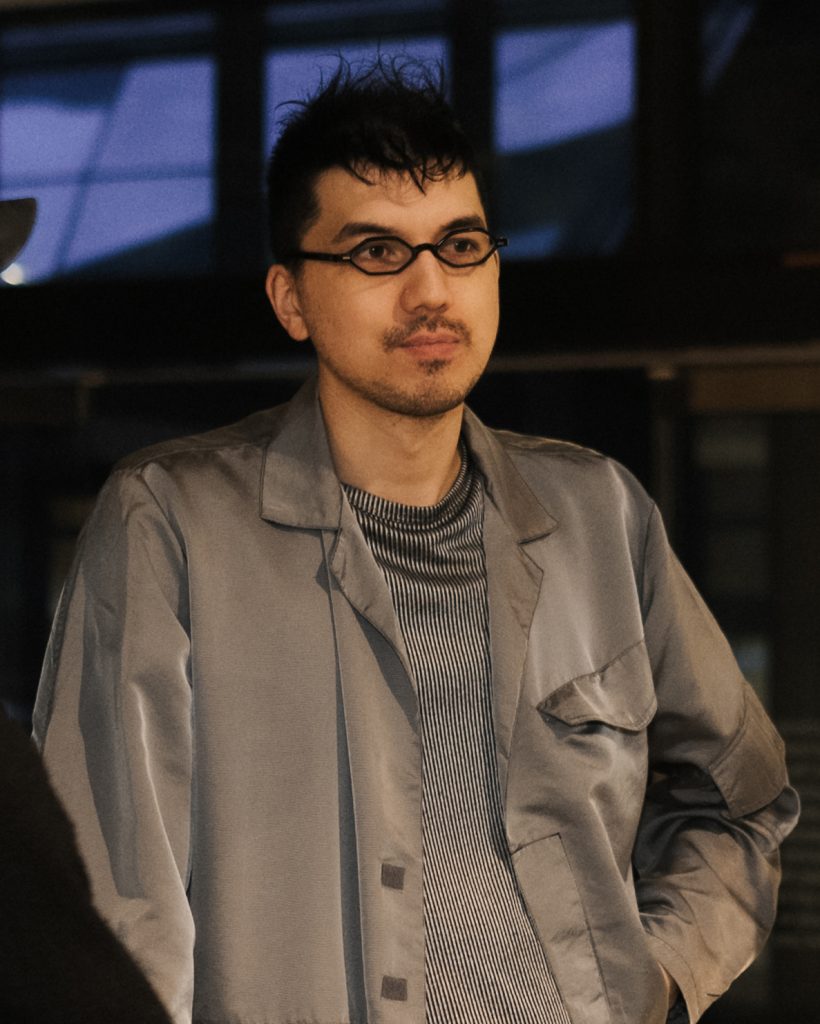
Over a thirty-year career trajectory, Yip has developed what he coins Hypersurrealism; a practice rooted in the transcription of fully realized compositions encountered during REM dream states. These works, which he refers to as Dream Artifacts, sit at the intersection of memory, image-making, and the subconscious, challenging familiar distinctions between the imagined and the tangible. His methodology was formally recognized by the CICA Museum in Korea through its 2022 exhibition and presentation at the International Symposium for Visual Culture, and his work was subsequently featured in Brave New World: New Media Art 2023, supported by the Ontario Arts Council.
Yip’s practice encompasses animation, visual art, electronic music, film, and design, including work under the musical alias Discrete and the founding of Savvy Records. His multidisciplinary output has earned recognition across both art and music contexts, including a JUNO Award nomination, international film selections, and exhibitions in Venice, Toronto, and Shanghai.
Across mediums, Yip interrogates the spaces between high and low, abstraction and representation, and spiritual and commercial semiotics, revealing unexpected connections between seemingly disparate visual and cultural languages.

Isabella Nicastro (IN): So I want to start off by asking what your experience as a longtime Partial artist has been like?
Kyle Yip (KY): Yeah, so I’ve been working with Partial gallery for around 10 years now, I suppose, and it’s been very positive. I would say that it’s a multifaceted kind of relation that we’ve developed over the years and, you know, includes, you know, live discussions such as these, which I think are so important in and around the discourse on contemporary art, but also some of the things like navigating the art industry that perhaps aren’t really as thoroughly explored in post secondary art institutions or traditional art curricula. And that’s navigating the art market and introducing yourself to prospective clients or just accessing different clientele and audiences such as the film industry or the design industry, architects and television and that sort of thing.
[Partial] also helped me fund my practice too, through, through various acquisitions over the years and, and kind of continue to grow my audience and my practice. It allowed me also to continue to engage with local and international galleries and museums, because I know a lot of represented artists. A lot of artists are seeking representation and there can be contractual kind of contradictions with working with various galleries, whether it’s virtual, online or physical. So [Partial] gives me this transitory platform to still work flexibly with other institutions in that process, if that makes any sense.
IN: It seems as though your practice is quite intuitively based, almost pre-planned, working backwards from pre-realized images of the shape that your artwork will end up taking. I wanted to ask if the concept of chance functions in your work; let’s say if you’re working on a physical piece, do you ever divert from the original dream transcription that you have of it as the piece progresses? Is there any sort of gap between the imagined work within the dreamscape and the one that’s created in the 3D reality?
KY: Yeah, so I guess I just want to first start by establishing like, what’s going on, because you said it very clearly. But for those who are new to my work, since approximately November 2017, I started experiencing recurring and recursive dreams about art. So I’ll have dreams where I’m seeing original paintings and sculptures and across many disciplines.
That’s the reason why I’m interdisciplinary; if I see it or hear it, you know, whether it’s music or art or design, I just try my best to make it as accurately as possible. So, going back to your question, it’s hard to say if it’s premeditated, because it’s an involuntary process: it’s not like I did certain things to invite this discourse- it just happened to me. And ever since, it’s been happening a lot, sometimes more than others.
So I try to mitigate that gap that you’re asking about to a zero now. It gets really nuanced: without kind of overanalyzing it, there are some exceptions. For example, like one of the first pieces I made, which was Dream Sculpture A1, which was for the Art Laguna Prize, I remember. I’ll give you an example. I had a dream about the sculpture, and I was working with the glass worker to realize the sculpture from a dream. And we had to make some modification to the vectors of the glass because, for safety reasons, it could short circuit if we did. The original was super dangerous, the glass was overlapping. It gets very technical.
My art is very technical, both conceptually and logistically, so I had to make some changes for that reason. Then what will happen is I’ll have retroactive dreams about it, too, so the original concept and everything comes to me in the dream originally. I haven’t seen them outside of dreams. Then sometimes I’ll have to make logistical or technical changes for safety reasons, for example, and then I’ll have a dream about it retroactively, like the final result. When I have that, it’s like kind of a confirmation that [the work] is done. It doesn’t always happen, but it’s usually when I have to make changes to the original; but that’s maybe 4% of the time, 95% of the time, it’s pretty much exactly or very close to the original.
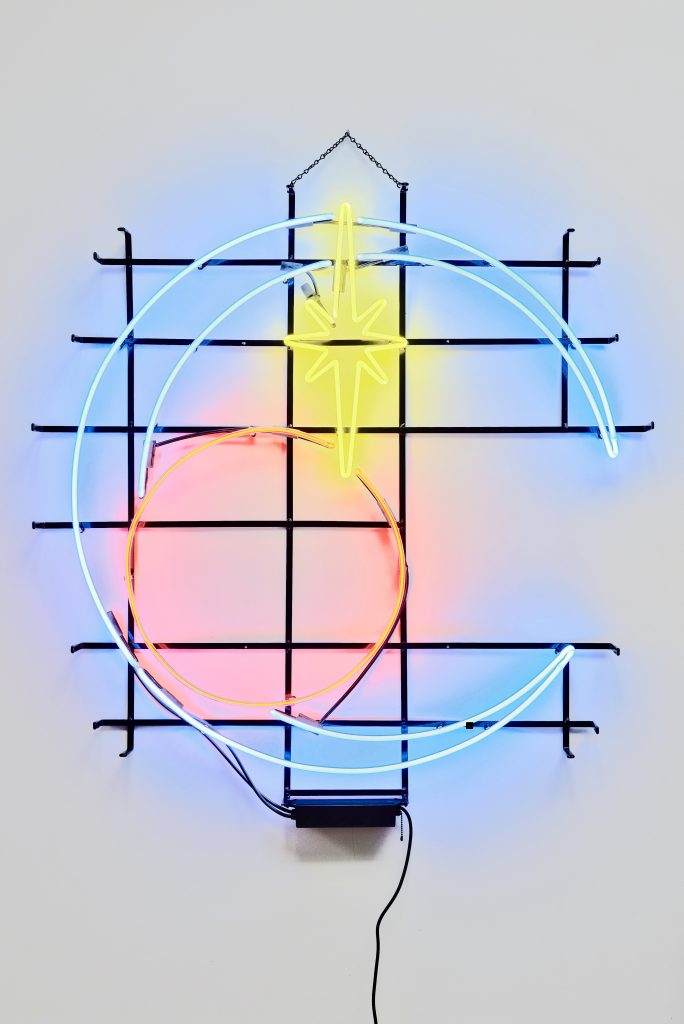
48 × 48 × 3 in.
IN: A lot of advertising and promotional material has these bright neon colours that are meant to draw in attention, and I do see a notable use of these neons and very vivid colours across your portfolio of work, especially in these Dream paintings. So I just wanted to ask if this was an intentional choice or if these are simply the colours that you’re seeing in your dream transcriptions?
KY: The latter, I mean, it simply is the colour palette. That’s the simple answer, but I believe that there’s a reason for everything. When we’re unclear about that, it’s more just a reflection of our ignorance, so I really believe that we need to learn how to decipher dreams. The work posits itself at the intersection between, you know, dream interpretation, but also conceptual art analysis. A lot of the questions I get are about creativity, you know, what’s your artistic and creative intent? It’s really just what I said at the beginning, which is I just wanted to see how accurately I could make the pieces, and I was able to do that with several series.
I do find that interesting because across various series from various recurring dreams, there are overarching colour schemes and colour palettes, signs and flags, ready-mades, and childhood nostalgia and toys. And there’s a lot of…a lot of references to the ready made and consumerism and commodity culture. I think that speaks to how much advertising and commercialism has kind of permeated or colonized the psyche and the tactics they use to kind of convey those messages are. There’s a colour psychology and there’s algorithms and there’s so many visual cues that you can be utilized to kind of manipulate people or convince people of certain things.

IN: A lot of your work features both commercial and spiritual semiotics as you’ve described it. I was just wondering if you can elaborate a little bit on what that looks like and what that means in the actual work itself?
KY: I could try. So what you see is exactly the way I see it. I’m very good at remembering the substrate, the medium, the dimensions, from 17 or 18 years of dream journaling, conditioning, and dream work and so forth. In terms of elaborating on the commercial versus spiritual aspects of the art, it’s an ambitious subject, you know, because we still don’t exactly know everything about dreams, let alone consciousness.
If you look at these examples, you will see high fashion logos that are deconstructed and what I view as a vexillological or flag oriented composition, which is more clearly evident with the flag oriented paintings or dream painting, F1, F2, where it’s stars and stripes. There seems to be this recursive motif about collective ego, nationhood, and this kind of interrogation of the US flag. Then there’s also this more singular individuated aspect represented by these independent high fashion haute couture designers. Where are we in the collective ego? For me, it’s more about questioning identity. Does identity matter? And there’s lots of layers to it.
Some art historians talk about how this is a consequence of commodity form and conditioning and how advertising has colonized the subconscious and how that kind of permeates these works or the dream world. I believe dreams are completely spiritual; it’s a different state of consciousness. Everything in dreams, I would argue, has spiritual connotations. But then there’s identifiable kind of vectors and icons and symbols, like you mentioned, that are reminiscent of this state of consciousness. I think they kind of influence one another and there’s an exchange, and that discourse I find very enriching. Going back again to the work and again, this idea of advertising symbols and things of that nature working their way into the subconscious.
Click here to view the full interview transcript. To learn more about Kyle Yip’s work, check out his Artist Profile on Partial